
Carroll County Court Records After Arrest
The court-record path starts after the booking event. The sheriff's jail page says the Carroll County Jail houses people for Juvenile Court, Municipal Court, and the Court of Common Pleas. A misdemeanor or lower-court criminal matter may appear in Municipal Court. A felony may begin with a complaint or preliminary proceeding, then move to Common Pleas through bindover, information, or indictment. Carroll County uses a Prosecuting Attorney, not a district attorney. Steven D. Barnett is listed as Carroll County Prosecuting Attorney in the Ohio Prosecuting Attorneys Association roster.
Jail booking detail is separate from the court record. The jail can confirm custody, visit rules, phone access, and some release issues. Court records show the formal case: filed charges, docket events, bond entries, pleas, dismissals, amendments, warrants, and final disposition. For custody and booking details, use Carroll County jail inmate records. For booking photos, use Carroll County jail mugshots and the sheriff records process.
Find Carroll County Court Records After Arrest
Two online court routes were documented. The Carroll County Municipal Court record search starts with a legal notice. That notice says the court's computer record information is limited by the retrieval system and may lag behind filings or judicial action by at least 24 hours. The Common Pleas public records docket offers search by party, associated party, and case number. The docket notice advises searching spelling variations of proper names.
- Decide whether the case is likely Municipal Court or Common Pleas. Misdemeanor and preliminary matters may begin in Municipal Court, while felony prosecutions are handled in Common Pleas.
- Open the Municipal Court record-search notice or the Common Pleas public-records docket.
- Search by defendant name. Use spelling variations if the first search fails.
- Use a case number when one appears on a citation, bond receipt, jail paperwork, or prior docket entry.
- Read the docket for charge status, bond entries, warrant entries, hearings, pleas, dismissals, and sentencing.
- Contact the clerk or visit during business hours when verified information is required.
The Common Pleas public-records docket screenshot shows the party, associated-party, and case-number search routes used for court records after a Carroll County arrest.
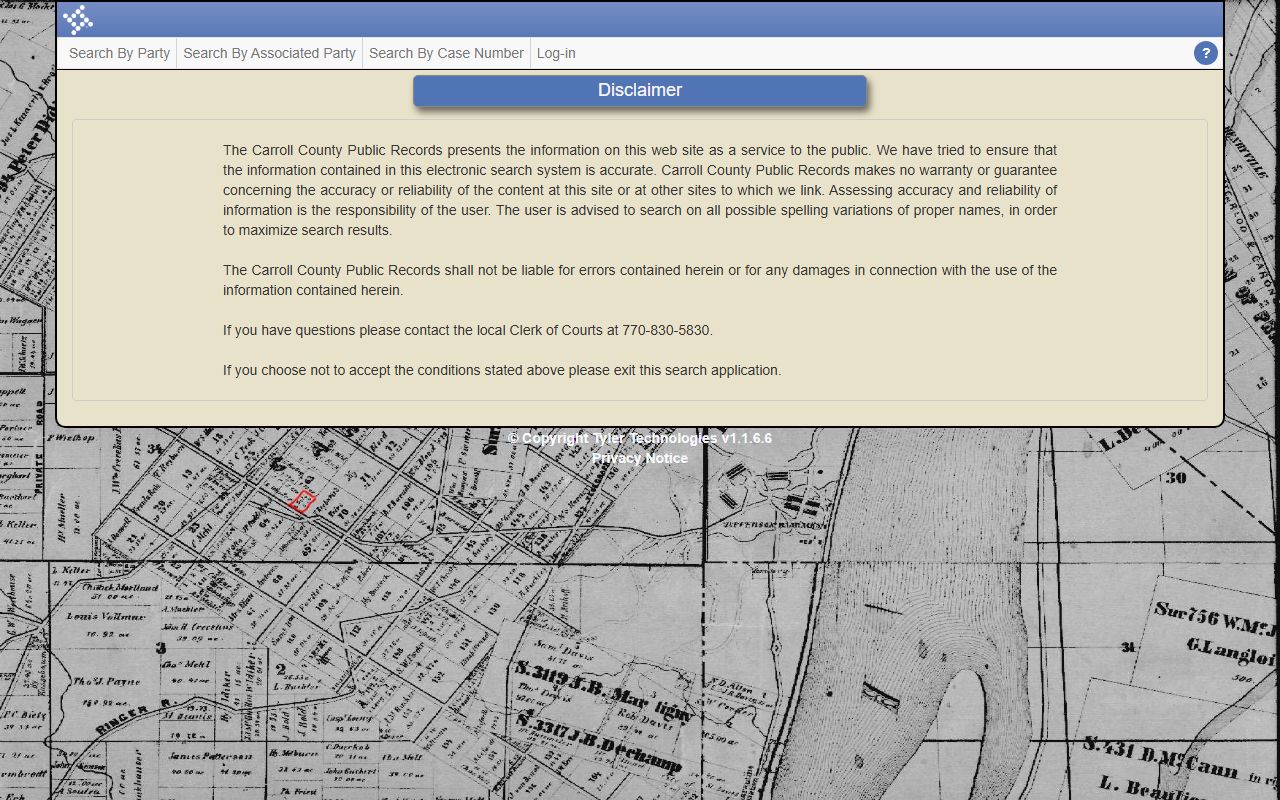
The docket route is useful after the case number or formal court filing exists, while the jail remains the source for immediate custody status.
Carroll County Court Search Fields
The Municipal Court post-notice search fields were not captured, so only the documented notice and access limit should be described. The Common Pleas public-records docket captured its search tabs. Those tabs matter when a defendant's name is misspelled, when a relative or other associated party is tied to a record, or when the court case number is known.
| Portal | Field / Tab | Required | Notes |
|---|---|---|---|
| Municipal Court Record Search | Continue from legal notice | Required to enter | Notice says data may lag by at least 24 hours. |
| Common Pleas Public Records Docket | Search By Party | Optional route | Use defendant name and spelling variations. |
| Common Pleas Public Records Docket | Search By Associated Party | Optional route | Useful when a person is connected to a case in another role. |
| Common Pleas Public Records Docket | Search By Case Number | Optional route | Best when a docket or case number is already known. |
| Common Pleas Public Records Docket | Log-in | Not required for public search shown | Public search routes are available without login. |
Charges Filed After an Arrest
An arrest starts the custody event, but a charging document starts or advances the court case. The prosecutor may file, amend, reduce, dismiss, or supersede charges as the case develops. Booking charges can reflect the arresting officer's suspected offenses or warrant basis at intake. Court charges are the formal allegations maintained in the court record.
| Document | Who Uses It | What It Does |
|---|---|---|
| Complaint | Often law enforcement or prosecutor | Starts a criminal case, especially in Municipal Court and preliminary felony matters. |
| Information | Prosecutor | Files charges when allowed by law and procedure. |
| Indictment | Grand jury | Charges felonies in Common Pleas after grand-jury action. |
Carroll County Charge Status
Charge status can change more than once. A person may be booked under one allegation, charged under another wording, and later face an amended count, reduced count, dismissed count, plea, trial finding, or sentence. Read the newest docket entry and the disposition for each count rather than assuming the first listed charge is final.
| Status | What It Means |
|---|---|
| Pending | The charge remains unresolved. |
| Amended | The wording, code, level, or factual basis changed. |
| Reduced | A lower-level offense replaced or modified the original charge. |
| Dismissed | The charge ended without a conviction on that count. |
| Nolle prosequi / nolle | The prosecutor declined to proceed on that charge where the term is used. |
| Bound over | The matter transferred from a lower court to Common Pleas for felony handling. |
| Convicted | The court entered a conviction after plea, trial, or finding. |
Bond After Carroll County Arrest
The Municipal Court homepage links to a bond schedule, but the detailed schedule was not captured in the research. Specific bond amounts should not be stated from the available materials. Bond questions should be routed through the jail for current custody and the proper court for official bond entries. A person's release may depend on more than one case or hold, so paying one bond may not release the person if another warrant, probation holder, parole holder, federal hold, or immigration detainer remains.
| Bond Type | How It Works |
|---|---|
| Cash bond | Money is deposited as ordered by the court. |
| Surety bond | A licensed bond agent posts surety under the court's conditions. |
| Recognizance or PR bond | Release is based on a promise to appear and may include conditions. |
| No-bond hold | Money alone will not release the person because a court or agency hold prevents release. |
Warrants and Carroll County Arrest Records
No official Carroll County sheriff active-warrant search page was located. Court records may show warrant activity within a case, but that is not the same as a countywide warrant list. A bench warrant may be issued for failure to appear or failure to comply with a court order. An arrest warrant authorizes arrest on a criminal charge. A fugitive warrant or holder from another jurisdiction can keep a person in custody even if a local bond issue is resolved.
For a person already booked on a warrant, call the Carroll County Jail or sheriff's office. For case-specific warrants, search Municipal Court and Common Pleas records. For warrant-related incident or arrest records that are not online and are not exempt, use the sheriff public-record request. Legal advice should come from an attorney, especially before someone appears in person on an active warrant.
Charges vs Convictions
A charge is an accusation in the court record. A conviction is a court outcome after a plea, trial, or finding. A jail arrest, a booking entry, and a pending charge should not be read as proof of guilt. The docket's final disposition is the place to verify whether a count ended in conviction, dismissal, amendment, reduction, or another result.
| Point | Charge | Conviction |
|---|---|---|
| Stage | Accusation or filed count | Final court finding or plea result |
| Can change? | Yes, charges may be amended or dismissed | Changed only through later court action |
| Where verified | Complaint, information, indictment, docket entries | Disposition and sentencing entries |
Sealed and Expunged Court Records
Ohio sealing and expungement law can limit public access to eligible criminal records. ORC 2953.32 covers applications for eligible conviction and bail-forfeiture records. ORC 2953.34 addresses the effect of sealing or expungement orders on public offices and questions about sealed or expunged records. A person with an order should work through the court that issued it and the agencies holding the affected records.
| Point | Sealed | Expunged |
|---|---|---|
| Public access | Limited from ordinary public view | Treated under the court order's expungement effect |
| Public offices | Must handle the record according to the order | Must handle the record according to the order |
| Next step | Use the issuing court and written requests | Use the issuing court and written requests |
Restricted Court Records After Arrest
Public access in Ohio is broad, but it is not absolute. Juvenile records, victim and witness information, investigatory work product, sealed records, expunged records, and some sensitive law-enforcement material may be restricted or redacted. The court docket may also lag behind an actual court action. The Municipal Court notice says verified information should be requested from the court or obtained during regular business hours.
Important: Court records, jail records, and search results should not be used for employment, housing, credit, insurance, or other FCRA-covered decisions.